Montessori has become one of the most requested words in private childcare. Parents ask for Montessori nannies, Montessori-inspired routines, and Montessori-friendly home environments. But behind the popularity lies a great deal of confusion. Many families use the term without fully understanding what it involves, and many nannies describe themselves as Montessori-trained without holding any recognised qualification. This article is an honest guide to what Montessori philosophy actually entails, what a genuinely Montessori-trained nanny does differently in practice, and how to decide whether this approach is the right fit for your child and your family.
What Montessori Philosophy Actually Involves
Montessori education was developed by Maria Montessori, an Italian physician and educator, in the early twentieth century. Her approach was based on careful observation of how children naturally learn, and it challenged many assumptions of the time about what young children need from adults. More than a hundred years later, her core principles remain distinctive and, in many cases, counter-intuitive for parents raised in more conventional educational traditions.
Child-Led Learning
Montessori rests on the belief that children are naturally curious and capable of directing their own learning. Rather than following a curriculum imposed by an adult, Montessori children are given freedom to choose their own activities within a carefully prepared environment. The adult's role is not to teach in the traditional sense, but to observe, guide, and provide the right materials at the right time.
This does not mean children do whatever they want. It means they are offered meaningful choices within clear boundaries. A Montessori nanny might present a child with three different activities and let the child choose which one to explore first. She would not force a child to complete a puzzle before moving on, but she would gently encourage concentration and completion. The distinction is subtle but important: the child's intrinsic motivation is respected, while the adult maintains the structure that makes genuine learning possible.
The Prepared Environment
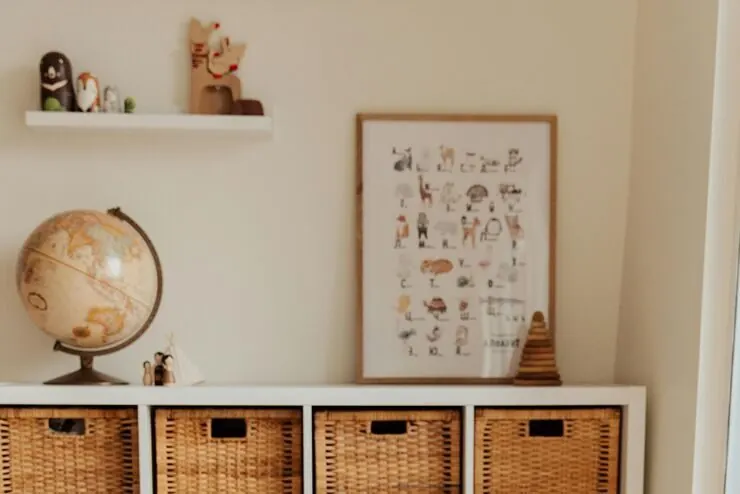
In Montessori, the physical environment is considered as important as the adult. A well-prepared environment is one where everything is intentionally placed, child-sized, accessible, and beautiful. Materials are arranged on low, open shelves. Each item has a specific purpose and a specific place. There is order without rigidity, and simplicity without deprivation.
The idea is that when the environment is well designed, the child can act independently. They can choose an activity, use it, and return it to its place without needing an adult to fetch, open, or organise things for them. This builds independence, concentration, and a sense of responsibility for their own space.
In Montessori, the environment does half the work. The adult's job is to prepare it thoughtfully and then step back.
Practical Life Skills
One of the most distinctive features of Montessori for young children is the emphasis on practical life activities. These are real, purposeful tasks drawn from everyday household life: pouring water, folding cloths, sweeping the floor, polishing shoes, preparing simple food, arranging flowers, buttoning and zipping clothing. To an outside observer, it can look remarkably mundane. To a Montessori educator, it is the foundation of everything.
Practical life activities serve multiple purposes. They develop fine motor skills and hand-eye coordination. They build concentration and sequencing ability. They give young children a sense of competence and contribution. And they satisfy a deep developmental need: the need to participate meaningfully in the life of their community. A two-year-old who is given a real sponge and a small bowl of water to clean a table is not being put to work. They are being trusted, included, and given the chance to do something that genuinely matters.
Independence and Respect
Maria Montessori famously urged adults to help children do things for themselves. This principle of fostering independence runs through every aspect of the approach. Montessori environments are designed so that children can dress themselves, serve their own food, clean up after themselves, and move freely without constant adult intervention.
This requires a particular kind of patience from the adult. It is almost always faster to put a child's shoes on for them than to wait while they struggle. But in Montessori thinking, that struggle is valuable. The child is learning not just how to put on shoes, but that they are capable of solving problems, that their efforts are worthwhile, and that the adult trusts them to manage. This respect for the child as a competent individual is perhaps the most defining characteristic of the Montessori approach.

What a Montessori-Trained Nanny Does Differently Day to Day
A nanny who genuinely understands Montessori will approach her day in ways that may look quite different from a conventional nanny. Here is what you might observe.
She observes before she intervenes. Instead of constantly directing or entertaining the child, a Montessori nanny will often step back and watch. She is looking for signs of what the child is interested in, what developmental stage they are in, and what kind of support, if any, they need. This observation is not passive. It is highly skilled and intentional.
She speaks less and demonstrates more. When introducing a new activity, a Montessori nanny will typically give a slow, clear demonstration without much verbal explanation. Young children learn primarily through watching and doing, not through listening to instructions. The nanny might silently show how to pour water from a small pitcher, moving deliberately so the child can absorb each step, then invite the child to try.
She avoids unnecessary praise. This is one of the aspects that surprises parents most. Rather than saying "Good job!" or "That's amazing!" at every achievement, a Montessori nanny will offer specific, descriptive feedback. "You poured the water all by yourself" or "I noticed you concentrated on that for a long time." The goal is to help the child develop intrinsic satisfaction rather than dependence on external validation.
She follows the child's pace. If a child is deeply engaged in an activity, a Montessori nanny will not interrupt them to move on to the next thing on the schedule. Concentration is considered sacred in Montessori philosophy. The nanny will protect a child's focus, even if it means adjusting the routine. She will also allow a child to repeat an activity as many times as they wish, understanding that repetition is how mastery develops.
She involves the child in daily routines. Mealtimes, tidying up, getting dressed, and preparing snacks are not things that happen to the child while the nanny manages. They are collaborative activities where the child is given age-appropriate responsibility. A Montessori nanny might have the child wash their own apple, spread butter on toast, or set the table with real, child-sized crockery.
Real Qualifications to Look For
The term "Montessori" is not legally protected, which means anyone can describe themselves as Montessori-trained regardless of their actual education. For families who want the genuine article, it is important to understand the credentialing landscape.
AMI (Association Montessori Internationale)
AMI was founded by Maria Montessori herself in 1929 and is considered the gold standard for Montessori training worldwide. An AMI diploma requires rigorous study, typically over one to two years of full-time coursework, hundreds of hours of supervised practice with children, and comprehensive examinations. AMI training centres exist in many countries, and the diploma is recognised internationally. A nanny with an AMI diploma has undergone serious, in-depth training and has a thorough understanding of Montessori philosophy and practice.
AMS (American Montessori Society)
AMS is the largest Montessori organisation in the United States and offers its own credentialing programme through affiliated training centres. AMS training is well regarded and comprehensive, though it allows for somewhat more flexibility and integration with other educational approaches than the stricter AMI model. An AMS-credentialed nanny is well trained and knowledgeable.
Other Training and Certificates
Beyond AMI and AMS, there are numerous shorter Montessori courses, online workshops, and certificate programmes. Some of these are excellent introductions to Montessori principles. Others are superficial. A weekend online course does not provide the same depth of understanding as a year-long diploma programme. When interviewing candidates, ask specifically about the name of the training centre, the duration of the programme, and whether it included supervised practice hours. A candidate who is genuinely well trained will be happy to discuss their education in detail.
The question is not whether someone knows the word Montessori. It is whether they understand the philosophy deeply enough to apply it naturally, flexibly, and with genuine respect for the child.
Setting Up a Montessori-Friendly Home
You do not need to transform your entire house into a Montessori classroom. But making a few thoughtful adjustments can support your nanny's work and make the approach more effective.
Low, open shelving. Replace toy boxes and closed cupboards with low, open shelves where a small, chosen set of activities is visible and accessible. Rotate items every week or two to maintain interest. Less is more. Five or six well-chosen activities are more effective than thirty jumbled in a basket.
Child-sized furniture and tools. A small table and chair, a stool that reaches the kitchen counter, a low coat hook, a child-sized broom. When furniture fits the child, they can use it independently, which is the entire point.
Real materials over plastic toys. Montessori environments favour natural materials: wood, glass, ceramic, metal, fabric. Real objects are more sensory-rich, more aesthetically pleasing, and more respectful of the child's developing taste. A small ceramic pitcher teaches more about care and consequence than a plastic one, because it can actually break.
Order and beauty. The environment should be tidy, calm, and visually harmonious. This does not mean sterile. It means intentional. A small vase of fresh flowers, a neatly folded cloth, a wooden tray with an activity arranged in sequence. The aesthetic communicates respect: this space was prepared for you, and it matters.
Accessible independence. Snacks at the child's level. A water pitcher they can pour from. Clothing stored in low drawers they can open themselves. Shoes arranged where they can put them on without help. Every small adjustment that allows the child to do something independently is a Montessori adjustment.
Age-Appropriate Montessori Activities
A Montessori nanny will draw on a wide repertoire of activities appropriate to the child's developmental stage. Here are examples of what this looks like at different ages.
Infants (0 to 12 Months)
For infants, Montessori focuses on providing a safe, stimulating environment and respecting the baby's natural rhythm. Activities include high-contrast visual mobiles hung above the crib, grasping objects made of natural materials, tummy time on a soft mat with a low mirror, and simple wooden rattles. The nanny will narrate daily activities calmly, allow the baby uninterrupted time to explore, and avoid overstimulation. Even at this age, the principle of respect applies: a Montessori nanny will tell the baby what she is about to do before picking them up or changing their nappy.
Toddlers (1 to 3 Years)
This is the golden age for practical life activities. Toddlers are naturally driven to imitate the adults around them, and a Montessori nanny will channel this impulse into purposeful work. Activities include pouring dry ingredients from one container to another, transferring objects with small tongs, scooping with a spoon, washing hands with a proper sequence, wiping tables with a sponge, putting on and removing shoes, and sorting objects by colour, size, or type. Simple art activities such as painting at an easel, tearing paper, and using child-safe scissors are also introduced.
Preschoolers (3 to 6 Years)
Between three and six, Montessori activities become more complex and begin to introduce early academic concepts through hands-on materials. A Montessori nanny might introduce sandpaper letters for tracing, number rods for counting, colour tablets for discrimination, and geography puzzles. Practical life activities continue but grow more sophisticated: preparing a simple salad, washing dishes, sewing with a blunt needle, gardening, and caring for pets. The emphasis remains on the child choosing their own work and developing deep concentration.
When the Montessori Approach May Not Be Ideal
Montessori is a powerful approach, but it is not the right fit for every child or every family. Being honest about its limitations is more useful than treating it as a universal solution.
Children who thrive on high energy and physical play. While Montessori absolutely includes movement and outdoor time, the emphasis on calm, focused, individual work can feel constraining for children who are naturally boisterous, highly physical, and social. Some children genuinely do better with more group play, more running around, and less time sitting with tabletop activities. A skilled Montessori nanny will adapt, but if your child's temperament is fundamentally at odds with the quiet concentration that Montessori values, it may not be the most natural fit.
Families who value structured academic preparation. If your priority is early reading, writing, and arithmetic in a traditional sense, Montessori's child-led, non-pressured approach may feel too slow or indirect. Montessori children do learn to read and count, but they do so on their own timeline, through hands-on materials rather than worksheets or formal instruction. Some families are comfortable with this. Others are not.
Homes where consistency is difficult. Montessori works best when the environment and the adult's approach are consistent. If the nanny is Montessori-trained but the rest of the household operates very differently, with screens on constantly, toys scattered everywhere, and adults routinely doing everything for the child, the effect is diluted. This does not mean the entire family must become Montessori converts. But there needs to be enough alignment that the nanny's approach is supported rather than undermined.
Children with specific developmental needs. While Montessori can be wonderfully effective for many children with additional needs, it is not a therapy. Children who require occupational therapy, speech therapy, or behavioural support need those interventions alongside, not instead of, an educational philosophy. A Montessori nanny can be part of a broader support team, but she should not be expected to replace professional therapeutic care.
Questions to Ask in Interviews
When interviewing a nanny who describes herself as Montessori-trained, these questions will help you gauge the depth of her understanding and experience.
- Where did you train, and how long was the programme? This is the most important question. Listen for the name of a specific, recognised training centre and a programme lasting at least several months.
- Can you describe what a typical morning would look like with my child? A knowledgeable candidate will describe observation, offering choices, following the child's interest, and incorporating practical life activities. She will not describe a rigid schedule of adult-directed lessons.
- How do you handle a child who refuses an activity or seems uninterested? A good answer will involve observing why the child is disengaged, considering whether the activity is developmentally appropriate, and offering alternatives without coercion.
- How do you approach discipline or challenging behaviour? A Montessori nanny will describe setting clear, consistent limits with respect and empathy. She will not use punishments or rewards systems. She will talk about redirecting, natural consequences, and understanding the underlying need behind the behaviour.
- What would you change about our home environment? A strong candidate will look around and offer thoughtful, practical suggestions about accessibility, organisation, and child-friendly adaptations. If she cannot identify anything, she may not be as experienced as her CV suggests.
- How do you feel about combining Montessori with other approaches? This is a useful litmus test. A rigidly dogmatic nanny may struggle in a family that also values creative play, imaginative storytelling, or other educational philosophies. The best Montessori nannies understand the principles deeply enough to integrate them flexibly.
Combining Montessori with Other Approaches
In practice, very few homes operate as pure Montessori environments. Most families blend elements of Montessori with other approaches, and this can work beautifully if done thoughtfully.
Montessori and Reggio Emilia share a respect for the child as a capable learner but differ in emphasis. Reggio places greater value on collaborative projects, artistic expression, and the role of documentation. A nanny who understands both can create an environment that encourages independent work alongside creative, open-ended exploration.
Montessori and RIE (Resources for Infant Educarers) are highly compatible, especially for infants and toddlers. Both emphasise respectful communication, uninterrupted play, and allowing children to develop at their own pace. Many nannies who work with very young children draw on both traditions naturally.
Montessori and imaginative play is where some tension exists. Traditional Montessori discourages fantasy play for very young children, preferring activities rooted in reality. Many modern Montessori practitioners have relaxed this stance, recognising that imaginative play is a natural and valuable part of childhood. A pragmatic nanny will balance the two, offering rich real-world experiences while also allowing space for the child's imagination to flourish.
The key is that the nanny understands Montessori principles well enough to know when she is adapting them, and why. A nanny who picks and chooses elements randomly without understanding the underlying philosophy is not blending approaches. She is improvising. There is a difference.
Finding the Right Fit
Ultimately, the question is not whether Montessori is the best approach in the abstract. It is whether a Montessori-trained nanny is the right person for your particular child, in your particular home, at this particular moment in your family's life.
If you are drawn to the values of independence, respect, simplicity, and purposeful activity, and if you are willing to support those values in how your home is organised and how your family operates, a Montessori nanny can be a transformative presence. But the nanny herself matters more than the label. A warm, perceptive, genuinely skilled caregiver who understands your child's needs will always be more valuable than a certification on a wall.
Look for someone who talks about children with respect and curiosity. Look for someone who asks you questions about your child before telling you what she would do. Look for someone whose eyes light up when she describes watching a child master something new. That is the Montessori spirit, whether or not it comes with an acronym.
International Service: We place Montessori-certified nannies internationally, from Monaco and the French Riviera to London, New York, Dubai, Geneva, and beyond.
Related Services
Looking for the right nanny?
Lumière matches families with professional caregivers. Let us find the perfect fit for your family.